The Context Layer for AI-Native Companies
AI-native teams can produce faster than they can understand. They need a context layer that turns human intelligence into usable input for people and agents.
Wissem Fathallah
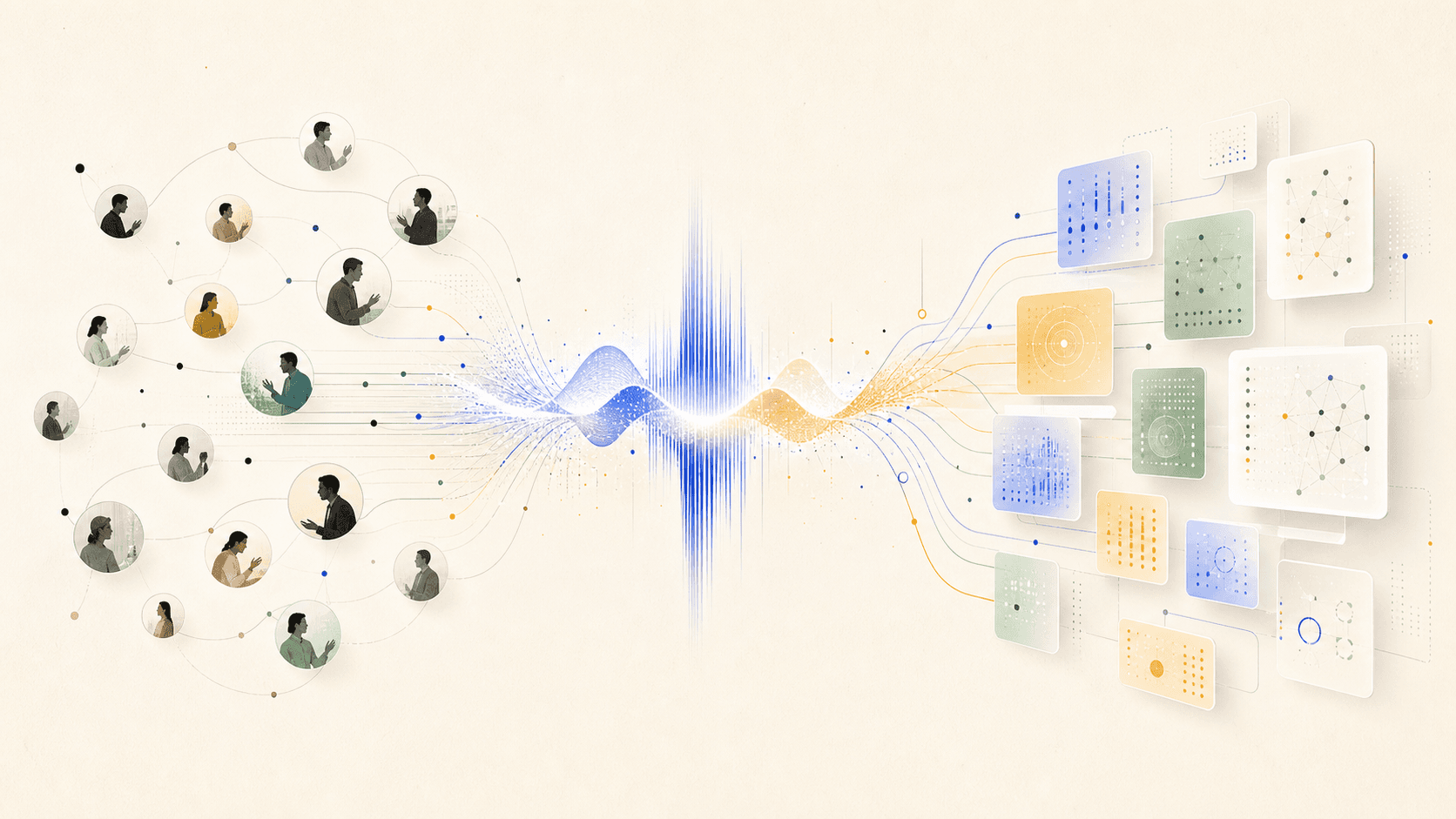
Every AI-native company eventually runs into the same constraint.
It can produce faster than it can understand.
The team can generate product specs, landing pages, sales emails, support docs, onboarding flows, research summaries, feature ideas, and experiment plans. It can ask models to synthesize, draft, rewrite, prioritize, and explain.
But the model can only work with the context the company has captured.
If the company's customer context is shallow, scattered, stale, or anecdotal, the AI system becomes a faster way to rearrange weak inputs.
That is why AI-native companies need a context layer.
What a context layer does
A context layer helps the company collect, preserve, and reuse the human context behind decisions.
Not just data.
Not just analytics.
Not just response rows.
Human context:
- why buyers care
- what alternatives they compare against
- which objections stop them
- what users expected at a key moment
- where workflows break
- what language customers use
- which segments feel urgent pull
- what proof would make a claim believable
- which decision the team should make next
This is the raw material that makes AI-generated work useful instead of merely fluent.
Why existing systems leave gaps
Most companies already have pieces of context.
Sales has call notes.
Support has tickets.
Product has feedback.
Marketing has message feedback.
Founders have memories.
Customer success has renewal conversations.
Analytics has behavior.
The issue is that these pieces are often trapped in the wrong shape.
They are scattered across tools, compressed into labels, summarized too early, or detached from the decision that needs them.
A dashboard can show where the funnel drops.
It cannot explain what the user believed should happen in that moment.
A short response can say "too expensive."
It cannot know whether the real issue is value clarity, budget timing, package fit, proof, comparison, or internal politics unless someone asks.
The follow-up is the missing primitive
The useful answer often appears after the first answer.
That is why good researchers, good founders, good salespeople, and good customer success leaders ask follow-up questions.
They do not ask follow-ups because they enjoy longer conversations.
They ask because the first answer is usually compressed.
The respondent says the product was confusing. The follow-up finds the moment.
The buyer says the price is high. The follow-up finds the comparison.
The customer says they need better reporting. The follow-up finds the decision the current report fails to support.
The prospect says the idea is interesting. The follow-up tests urgency.
Old input systems made it easy to collect first answers.
AI-native companies need systems that collect the context behind them.
Why voice matters
Voice is not useful because it is novel.
Voice is useful because people can explain a messy situation faster than they can type it into a box.
The respondent can tell the story in their own words. The system can ask one or two useful follow-up questions. The team can get the transcript, summary, themes, quotes, and next actions without forcing every useful context moment into a calendar bottleneck.
The workflow still has the distribution advantages of a link.
But it captures more of the reasoning, language, examples, and tradeoffs that fixed inputs usually miss.
The operating system changes
When human context becomes easier to collect, the company's operating system changes.
Product can test what users are actually trying to do before building the requested feature.
Marketing can use customer language instead of inventing positioning from internal preference.
Sales can enter demos with the buyer's workflow, urgency, and objections already visible.
Customer success can understand churn, onboarding friction, renewal risk, and expansion pull with more nuance.
Founders can see where the market is pulling before betting another quarter.
AI systems can produce with better grounding because the company has better inputs.
What Lemma is building
Lemma is building the context layer for AI-native companies.
The first concrete interface is an adaptive voice conversation.
Teams create a conversation around what they need to understand, send a link, and let respondents answer by voice. Lemma asks useful follow-up questions and turns the responses into transcripts, summaries, themes, quotes, context reports, and next actions.
Use it where the team needs human context faster than its current workflow can collect it.
That might be founder market pull, product-led sales context, customer feedback, churn, message testing, client intake, customer proof, or stakeholder alignment.
Different workflows.
Same underlying need.
The company needs better human context before it builds, sells, supports, prioritizes, or briefs agents.
The point
The next advantage is not simply who can generate more output.
It is who can feed AI systems, teams, and decisions with better context.
AI made building cheap.
It made context the scarce resource.